
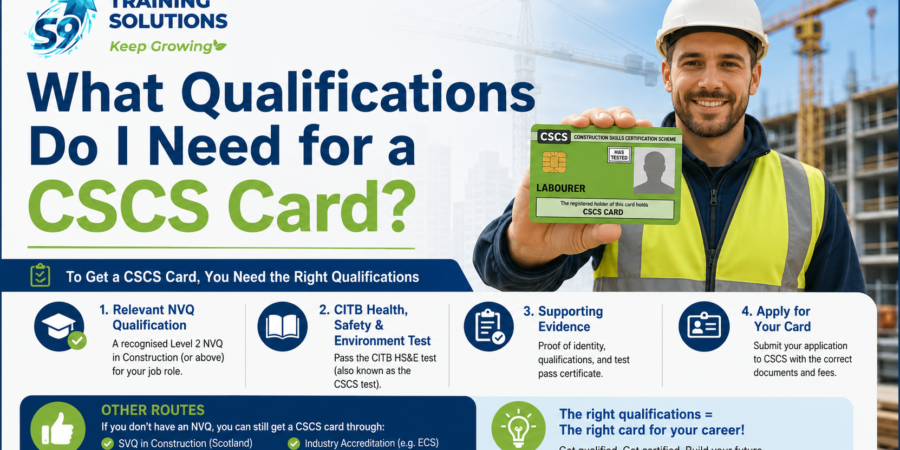
What Qualifications Do I Need for a CSCS Card?
Many people starting a career in construction know they need a CSCS card but are unsure about the qualifications required before applying. A common mistake is completing training without checking whether it matches the card they need.
The correct CSCS Card Qualifications depend on your job role, experience level, and career goals. A laborer entering the industry will need different qualifications compared with a skilled tradesperson, supervisor, or construction manager. Understanding the requirements before booking a course can save time, reduce costs, and help you choose the right career pathway.
A CSCS card demonstrates that a worker has the necessary training, knowledge, and competence to work safely on construction sites. Although a CSCS card itself is not a qualification, it confirms that you have completed recognized training and assessments relevant to your role.
The Construction Skills Certification Scheme (CSCS) supports employers by providing a recognized way to check whether workers have the appropriate qualifications and health and safety awareness. Whether you are applying for your first Green Labourer Card or progressing towards a management-level card, understanding CSCS Card Qualifications is an important step towards building a successful construction career.
CSCS Card Qualifications at a Glance
Before choosing a course, it helps to understand the typical qualification routes for different CSCS cards.
| CSCS Card Type | Typical Qualification Route | Suitable For |
|---|---|---|
| Green Labourer Card | Level 1 Health and Safety in a Construction Environment | New construction workers and labourers |
| Blue Skilled Worker Card | NVQ Level 2 or recognised trade qualification | Skilled tradespeople |
| Gold Supervisor Card | NVQ Level 3/4 Supervisory qualification | Supervisors and team leaders |
| Black Manager Card | NVQ Level 6/7 Construction Management qualification | Site managers and senior professionals |
The exact requirements can vary depending on your occupation, so always check the latest guidance before starting training.
Official information: https://www.cscs.uk.com/
Why Do CSCS Card Qualifications Matter?
Construction sites involve many hazards, including working at height, operating machinery, handling materials, and working around other contractors. Employers need confidence that workers understand safe working practices before allowing them onto site. CSCS Card Qualifications help demonstrate that workers have completed suitable training and understand their responsibilities.
Benefits of having the correct qualifications include:
- Improved employment opportunities.
- Easier access to construction sites.
- Increased employer confidence.
- Better understanding of workplace safety.
- Clear career progression opportunities.
- Recognition of professional skills.
For employers, qualified workers help create safer and more efficient workplaces. For employees, gaining the correct qualifications can open doors to better roles and higher earning potential. Choosing the wrong qualification can delay your CSCS application, so it is important to understand which route matches your career stage.
Which Qualification Do You Need for Your CSCS Card?
The qualification you need depends mainly on your current role and where you want your construction career to go.
Qualifications for Construction Labourers
People starting in construction usually apply for the Green Labourer CSCS Card. This is the most common entry route for beginners who want to gain site experience.
Typical CSCS Card Qualifications for labourers include:
- Level 1 Award in Health and Safety in a Construction Environment.
- CITB Health, Safety and Environment Test.
- Basic construction safety awareness.
This training covers essential topics such as:
- Identifying workplace hazards.
- Using personal protective equipment.
- Following safe working procedures.
- Understanding site responsibilities.
- Reporting unsafe conditions.
The Green Laborer Card provides a foundation for workers who want to develop their skills and progress into skilled trades or supervisory positions.
Qualifications for Skilled Workers
Workers who already have experience in a specific trade usually require a Blue Skilled Worker CSCS Card. This card is designed for people who have completed recognized vocational training.
Examples of skilled construction roles include:
- Bricklayers.
- Carpenters.
- Electricians.
- Plumbers.
- Painters.
- Groundworkers.
- Plant operators.
Typical CSCS Card Qualifications for skilled workers may include the following:
- NVQ Level 2 qualification.
- Apprenticeship qualification.
- Industry-recognised trade certificate.
- Relevant occupational qualification.
These qualifications demonstrate that a worker has both theoretical knowledge and practical ability within their chosen trade. A skilled worker qualification also helps employers confirm that someone can complete tasks safely and effectively.
Qualifications for Supervisor Roles
Workers who want to move into supervisory positions usually need additional qualifications beyond trade experience. Supervisors are responsible for managing teams, monitoring work quality, and ensuring safe working practices are followed. The Gold Supervisor CSCS Card is commonly associated with supervisory qualifications.
Typical requirements may include the following:
- NVQ Level 3 or Level 4 supervisory qualification.
- Relevant construction experience.
- CITB Health, Safety, and Environment Test.
Supervisory training often covers:
- Team management.
- Site coordination.
- Risk assessment.
- Communication skills.
- Health and safety responsibilities.
- Monitoring construction activities.
Gaining supervisory qualifications can help experienced workers move into leadership roles and increase their career opportunities.
Qualifications for Construction Managers
Construction managers have greater responsibilities, including planning projects, managing resources, and ensuring work is completed safely and efficiently. The Black Manager CSCS Card is designed for senior construction professionals.
Common CSCS Card Qualifications for managers include the following:
- NVQ Level 6 Construction Site Management.
- Higher-level construction management qualifications.
- Relevant leadership experience.
Management-level qualifications usually cover areas such as:
- Project planning.
- Risk management.
- Legal responsibilities.
- Cost control.
- Team leadership.
- Quality management.
For workers aiming to become site managers, completing higher-level qualifications is an important part of career development.
Do Apprentices Need CSCS Card Qualifications?
Apprentices entering the construction industry may also need to meet specific CSCS requirements depending on their role. Apprentices usually follow a structured training pathway that combines classroom learning with practical workplace experience.
Their route may include:
- Apprenticeship qualifications.
- Health and safety training.
- CITB Health, Safety, and Environment Test.
- Employer assessments.
Starting the correct qualification pathway early can help apprentices build strong foundations for future career progression.
Can Experience Replace Qualifications?
Many experienced construction workers wonder whether years of site experience can replace formal qualifications. In some cases, experienced workers may already have the practical skills needed for their role. However, many CSCS cards still require recognized qualifications or evidence of competence.
Experience is valuable, but qualifications provide official recognition of your abilities. Workers with extensive experience should check whether they can complete an experienced worker assessment or qualification route instead of starting from the beginning. Understanding your available options can help you choose the fastest and most suitable way to meet CSCS Card Qualifications.
Common Mistakes When Choosing CSCS Qualifications
Many applicants experience delays because they choose unsuitable courses or do not check requirements before applying.
Common mistakes include:
Completing an Unrecognised Course
Not every construction course is accepted for CSCS applications. Always confirm that your qualification meets current CSCS requirements.
Choosing the Wrong Card Route
A laborer, skilled worker, supervisor, and manager all require different qualification pathways.
Ignoring CITB Test Requirements
Many applicants complete training but forget that they also need to pass the relevant CITB Health, Safety, and Environment Test.
Starting Without Checking Career Goals
Choosing a qualification based only on your current job may limit future progression. Consider where you want your construction career to go.
Planning your qualification route carefully helps you avoid unnecessary costs and delays.
How to Choose the Right CSCS Card Qualifications
Choosing the correct qualification pathway is one of the most important decisions when applying for a CSCS card. Many workers focus only on getting a card quickly, but selecting the right qualification can have a major impact on future career progression.
Before starting any course, consider:
- Your current construction role.
- Your level of experience.
- The type of work you want to do.
- The CSCS card you need.
- Your long-term career goals.
For example, a person starting as a laborer should not immediately complete management-level training. Instead, they should build their knowledge and experience gradually through the correct qualification route.
The right CSCS Card Qualifications help you meet employer expectations, improve your skills, and create opportunities for career development.
Do You Always Need an NVQ for a CSCS Card?
Whether you need an NVQ depends on the type of CSCS card you are applying for. NVQs are commonly required for skilled, supervisory, and management-level cards because they demonstrate occupational competence.
However, not every CSCS card requires an NVQ.
For example:
- Green Labourer Card applicants usually need a Level 1 Health and Safety qualification.
- Blue Skilled Worker Card applicants often need an NVQ Level 2 or equivalent trade qualification.
- Gold Supervisor Card applicants usually need supervisory qualifications.
- Black Manager Card applicants generally need higher-level management qualifications.
NVQs are valuable because they prove that a worker can complete tasks safely and effectively in a real workplace environment. For experienced workers, alternative assessment routes may sometimes be available depending on their occupation and circumstances.
Understanding the CITB Health, Safety and Environment Test
The CITB Health, Safety and Environment Test is an important requirement for many CSCS card applications. The purpose of the test is to ensure workers understand essential health and safety principles before working on construction sites.
The test covers areas such as:
- Health and safety responsibilities.
- Identifying workplace hazards.
- Safe use of equipment.
- Personal protective equipment.
- Manual handling.
- Fire safety.
- Environmental awareness.
- Emergency procedures.
Passing the CITB test shows employers that you understand the basic safety standards required within the construction industry.
Official CITB information: https://www.citb.co.uk/
Before booking your test, always check which version applies to your chosen CSCS card. Taking the correct test is an important step alongside completing your CSCS Card Qualifications.
How Long Does It Take to Complete CSCS Qualifications?
The time required depends on the qualification level, your previous experience, and the training route you choose. A beginner applying for a Green Laborer Card may complete the process relatively quickly because the entry requirements are straightforward.
However, higher-level qualifications may take longer.
Approximate timelines depend on:
- Course length.
- Assessment requirements.
- Existing knowledge.
- Workplace evidence.
- Availability of training.
For example:
A new laborer may need time to complete health and safety training and prepare for the CITB test. An experienced supervisor or manager completing an NVQ may require workplace assessments and evidence collection over a longer period. Planning your training early helps avoid delays when applying for construction roles.
How Much Do CSCS Card Qualifications Cost?
The cost of CSCS Card Qualifications varies depending on the card type, training provider, qualification level, and additional requirements.
Costs may include:
- Training fees.
- Qualification fees.
- CITB Health, Safety, and Environment Test fee.
- CSCS application fee.
- Study materials.
Entry-level routes are usually less expensive compared with advanced qualifications for supervisors and managers.
Before choosing a course, compare:
- Course content.
- Qualification recognition.
- Trainer experience.
- Support provided.
- Industry reputation.
Choosing a recognized training provider helps ensure your qualification supports your CSCS application and career goals.
Benefits of Completing the Correct CSCS Qualifications
Completing the right qualifications provides benefits beyond simply obtaining a CSCS card.
Improved Job Opportunities
Many employers prefer workers who already have recognized qualifications because they can demonstrate their skills and safety awareness.
Better Career Progression
Qualifications create a clear pathway from entry-level roles to skilled, supervisory, and management positions.
For example:
Labourer → Skilled Worker → Supervisor → Site Manager
Each stage requires additional knowledge and experience.
Increased Workplace Confidence
Proper training helps workers understand their responsibilities and complete tasks safely.
Employer Recognition
Recognized qualifications help employers identify workers who are committed to professional development.
Why Choose S9 Training Solutions for Construction Training?
Choosing the right training provider can make completing your CSCS Card Qualifications easier and more effective. S9 Training Solutions provides construction training designed to support learners at different career stages. Whether you are entering construction for the first time or looking to progress into a management position, professional training support can help you understand your requirements and prepare successfully.
S9 Training Solutions supports learners through:
- Industry-focused courses.
- Experienced trainers.
- Flexible learning options.
- Qualification guidance.
- Career progression support.
If you are unsure which qualification route is suitable for your role, getting professional advice can help you avoid choosing the wrong course.
Useful links:
S9 Training Solutions: https://s9trainingsolutions.com/
Construction Training Courses: https://s9trainingsolutions.com/shop/
Contact S9 Training Solutions: https://s9trainingsolutions.com/contact/
CSCS Official Website: https://www.cscs.uk.com/
CITB Official Website: https://www.citb.co.uk/
Health and Safety Executive Construction Guidance: https://www.hse.gov.uk/construction/
These resources provide updated guidance to help workers understand their responsibilities and training requirements.
Frequently Asked Questions About CSCS Card Qualifications
What are the basic CSCS Card Qualifications for beginners?
Beginners usually need suitable CSCS Card Qualifications, including a Level 1 Health and Safety qualification, and must pass the relevant CITB Health, Safety and Environment Test. These requirements are commonly linked to the Green Labourer Card, which is the starting point for many people entering the UK construction industry and building their construction careers.
Do all CSCS cards require the same qualifications?
No. Different CSCS Card Qualifications are required for different CSCS cards based on the worker’s role and responsibilities. Labourers, skilled workers, supervisors, and managers follow separate qualification pathways depending on their experience level, current position, and future career goals within the construction industry.
Can I get a CSCS card without an NVQ?
Some CSCS Card Qualifications do not require an NVQ. For example, the Green Labourer Card usually requires a health and safety qualification instead. However, skilled worker, supervisor, and manager cards often require NVQ qualifications or equivalent recognised training to demonstrate the necessary skills, knowledge, and competence for their specific construction roles.
Which qualification is needed for a Green CSCS Card?
Most Green Labourer Card applicants need suitable CSCS Card Qualifications, including a Level 1 Health and Safety in a Construction Environment qualification, and must pass the CITB Health, Safety and Environment Test before applying. Completing the correct training ensures beginners meet the required standards and are prepared to work safely on construction sites.
What qualification do I need for a Blue CSCS Card?
A Blue Skilled Worker Card usually requires recognised CSCS Card Qualifications, such as an NVQ Level 2 or equivalent trade qualification. The qualification should match the worker’s specific occupation and demonstrate competence in their trade, helping employers confirm that the individual has the required skills and knowledge to work safely on construction sites.
Are CSCS qualifications difficult to complete?
How do I know which CSCS qualification I need?
The correct qualification depends on your job role, experience, and career goals. Understanding the right CSCS Card Qualifications for your situation is essential before starting any training. Checking the official CSCS requirements or speaking with a recognised training provider can help you choose the correct pathway and avoid completing unsuitable courses.
Can experienced workers gain CSCS qualifications?
Yes. Experienced workers may have different options depending on their skills and occupation. Some may complete assessments that recognise existing competence instead of starting from basic training. Understanding the available CSCS Card Qualifications pathways can help experienced workers choose the most suitable route to prove their skills and progress within the construction industry.
How long are CSCS Card Qualifications valid?
The validity depends on the qualification and card type. CSCS cards usually have expiry dates, and workers should check renewal requirements before their card expires. Understanding how CSCS Card Qualifications relate to your card type can help you maintain the correct certification, complete any required updates, and continue working on construction sites without unnecessary delays.
Where can I complete CSCS Card Qualifications?
You can complete approved construction training through recognised training providers such as S9 Training Solutions. A professional provider can help you choose suitable courses, understand the right CSCS Card Qualifications for your career goals, and prepare for required assessments. This support ensures you follow the correct training pathway and improve your chances of successfully meeting CSCS requirements.
Conclusion
Understanding CSCS Card Qualifications is essential for anyone planning to work or progress within the UK construction industry. The qualification you need depends on your role, experience level, and the CSCS card you want to obtain. Beginners usually start with entry-level health and safety training, while skilled workers, supervisors, and managers require higher-level qualifications that match their responsibilities.
Choosing the correct training pathway helps you avoid delays, improve your employability, and build a stronger construction career. Whether you are starting as a labourer or working towards a management position, completing recognised qualifications is an important investment in your future. With the right training, preparation, and professional support, you can achieve the qualifications needed to access more opportunities and succeed in the construction industry.
