
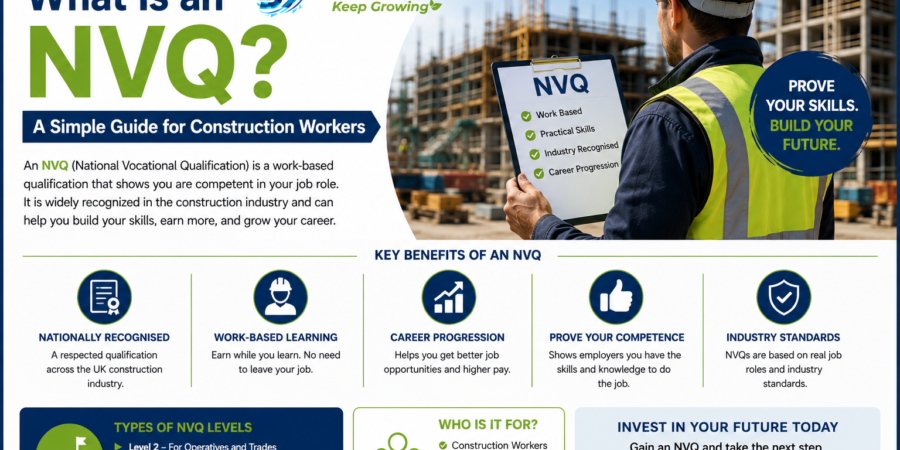
What Is an NVQ?
If you work in construction, you have probably heard people talk about NVQs. You may have also seen NVQ qualifications mentioned when looking for a CSCS card, applying for a new job, or planning your next career step.
But what is an NVQ, and why are these qualifications important in the construction industry?
NVQ stands for National Vocational Qualification. It is a work-based qualification designed to assess whether a person has the knowledge and practical skills needed to carry out a particular job competently.
Unlike a traditional qualification that may depend heavily on classroom learning and written examinations, an it focuses strongly on practical competence.
For construction workers, this can be particularly useful because many roles depend on what you can actually do on site, not simply what you know from a textbook. An NVQ can therefore be an important part of developing your career, demonstrating competence, and working towards certain construction card requirements.
How Does it Work?
It is based around the skills and responsibilities associated with a specific occupation. Rather than simply attending classes and sitting one final examination, learners normally provide evidence showing that they can perform their job to the required standard.
The assessment process can involve:
- Workplace observations.
- Questions and professional discussions.
- Photographs or other evidence where appropriate.
- Work records.
- Supporting documentation.
- Evidence of completed tasks.
- Feedback from relevant people.
The exact assessment method depends on the qualification. The important point is that it is designed to assess competence in a real occupational setting.
Why Are NVQs Popular in Construction?
Construction is a practical industry. A skilled worker needs to be able to use tools, follow safe procedures, understand drawings or specifications where relevant, complete tasks correctly, and meet the standards expected for their occupation.
An NVQ provides a structured way of assessing these practical abilities. This is one reason NVQs are widely associated with construction careers.
They can be relevant to occupations such as:
- Bricklaying.
- Carpentry and joinery.
- Plant operations.
- Site supervision.
- Construction management.
- Health and safety.
- Building services.
- Civil engineering.
- Other specialist construction occupations.
The qualification you need depends on your particular job role.
What Are the Different NVQ Levels?
One of the easiest ways to understand NVQs is to look at the different qualification levels. The level indicates the complexity and responsibility associated with the qualification.
Level 1
Level 1 qualifications generally cover introductory knowledge and basic skills. They can be suitable for people who are beginning to develop knowledge in a particular occupational area.
However, not every construction career starts at Level 1.
Level 2
Level 2 is commonly associated with skilled occupational roles. For construction workers, an NVQ Level 2 may demonstrate competence in a specific trade or occupation.
Examples can include qualifications related to:
- Construction operations.
- Plant operations.
- Brickwork.
- Carpentry.
- Plastering.
- Other skilled occupations.
The exact qualification depends on the occupation.
Level 3
Level 3 qualifications involve a higher level of knowledge, skill, and responsibility. They can be relevant to experienced workers, supervisors, and people taking on more responsibility within construction. For someone planning to progress from skilled work into supervision, a Level 3 qualification may form part of their career development.
Level 4 and Above
Higher-level vocational qualifications can involve more complex responsibilities, technical knowledge, management, or specialist areas. Construction professionals may pursue higher-level qualifications as they progress towards supervisory, management, or specialist positions. The appropriate level depends on your occupation and career goals.
Do You Need an NVQ for a CSCS Card?
This is one of the most common questions construction workers ask.
The answer is: it depends on the CSCS card you want.
Different CSCS cards have different requirements.
For example, certain skilled worker card routes may require an appropriate occupational qualification.
Higher-level cards can also have qualification requirements linked to the responsibilities of the role.
However, not every CSCS card requires an NVQ.
For example, some entry-level routes have different qualification requirements.
This is why you should identify your intended card and occupation before paying for a qualification.
You can check the latest requirements using the official CSCS website.
Can You Complete an NVQ While Working?
Yes, this is one of the major advantages of work-based qualifications. Because assessment is linked to your practical work, you may be able to complete an NVQ while continuing your normal employment. This can be particularly convenient for construction workers who do not want to leave employment to attend full-time college.
Instead, your assessor can evaluate evidence from your workplace and assess whether you meet the required standards. However, you need to be carrying out suitable work that allows you to generate the evidence required by your particular qualification.
Do You Need to Attend College for an NVQ?
Not necessarily.
The delivery method depends on the qualification and training provider. Some learners may attend training sessions, while others complete much of the qualification through workplace assessment and evidence collection.
An NVQ is fundamentally work-based, so practical evidence is an important part of the process. If you are already working in your chosen occupation, speak with a suitable training provider to understand how the assessment can fit around your job.
How Is an NVQ Assessed?
Assessment is usually focused on whether you can demonstrate the required competence. Your assessor may review your work and ask questions about how and why you carry out particular tasks.
Workplace Observation
An assessor may observe you carrying out relevant activities. This allows them to see your practical skills directly.
Questions
You may be asked questions to confirm your understanding of the work you are carrying out. These questions can help demonstrate that you understand the principles behind your practical activities.
Evidence
You may need to provide supporting evidence. Depending on the qualification, this could include workplace documentation, records, photographs, or other appropriate evidence.
Professional Discussion
An assessor may discuss your work with you to understand your knowledge, decision-making, and responsibilities. The exact assessment approach depends on the qualification and awarding requirements.
How Long Does an NVQ Take?
There is no single completion time for every NVQ.
The duration can depend on:
- Qualification level.
- Occupation.
- Your existing experience.
- Amount of workplace evidence available.
- Your availability.
- Assessment requirements.
- Training provider.
- How quickly you can complete outstanding evidence.
An experienced worker who already performs the required duties may progress more quickly than someone who is still developing their practical skills. This is why you should ask the training provider for an estimated timeframe based on your individual circumstances.
Can Experienced Construction Workers Get an NVQ?
Yes.
An NVQ can be particularly suitable for experienced workers who already have practical skills but need a formal qualification to demonstrate their competence. You may already have years of construction experience without holding a formal vocational qualification.
Rather than assuming you need to start from the beginning, discuss your experience with an appropriate training provider. Depending on the qualification, your existing competence and workplace evidence may be taken into account during the assessment process.
What Are the Benefits of an NVQ?
An NVQ can provide several advantages for construction professionals.
1. Demonstrates Practical Competence
The qualification provides evidence that you can perform the required duties for your occupation to the relevant standard.
2. Supports Career Progression
Completing an NVQ can help you work towards higher-level roles where relevant qualifications are expected.
3. Can Support CSCS Progression
Depending on the qualification and card route, an NVQ may help you meet the occupational qualification requirements for certain CSCS cards.
4. Recognises Existing Skills
Experienced workers may be able to demonstrate competence through their existing workplace activities rather than learning everything from scratch.
5. Builds Professional Confidence
Working through an organized assessment process can help you identify strengths and areas where further development may be useful.
6. Helps Employers Understand Your Competence
A recognized qualification gives employers additional evidence of your occupational skills.
7. Supports Long-Term Development
An NVQ can form one part of a longer construction career pathway.
NVQ vs Traditional Classroom Qualifications
An NVQ is different from a qualification that relies primarily on classroom-based study and examinations.
The biggest difference is the emphasis on workplace competence.
With an NVQ, you normally need to demonstrate that you can perform relevant tasks in practice. This can make vocational qualifications particularly relevant to construction. However, this does not mean classroom learning is unimportant.
Construction professionals may need a combination of:
- Practical experience.
- Vocational qualifications.
- Health and safety training.
- Industry-specific training.
- Management training.
The best combination depends on your career.
NVQ and Construction Career Progression
An NVQ can fit into different stages of a construction career.
A simplified pathway might look like:
Trainee → Skilled Worker → Supervisor → Manager
At each stage, the type and level of training you need can change. For example, someone working as a skilled tradesperson may pursue a Level 2 qualification relevant to their occupation. Someone progressing into supervision may need additional qualifications and training.
A construction manager may require higher-level qualifications related to management and construction operations. The important thing is to plan your qualifications around the role you want to achieve rather than choosing a qualification simply because it has a higher level.
How to Choose the Right NVQ
Choosing an NVQ should start with your occupation.
Ask yourself:
What job do I currently do?
Your qualification should relate to the work you actually carry out.
What card or qualification do I need?
If your goal is a particular CSCS card, check its current requirements first.
What position do I want next?
If you want to progress into supervision or management, consider what qualifications may be required for that next stage.
What experience do I already have?
Your existing experience can be important when discussing the most suitable route.
Can I generate the required workplace evidence?
Make sure your current work provides opportunities to demonstrate the skills covered by the qualification.
How S9 Training Solutions Can Help
Choosing the correct qualification can sometimes be confusing, particularly if you are unfamiliar with the UK construction qualification system. S9 Training Solutions provides construction training and qualification options designed to support people at different stages of their careers.
Whether you are developing your skills, working towards a construction qualification, or planning your next career step, professional guidance can help you understand which training route may be appropriate.
You can visit S9 Training Solutions to explore its construction training options.
You can also browse the available construction courses and compare options based on your career goals.
What Should You Prepare Before Starting an NVQ?
Before enrolling, gather information about your current role and experience.
It can be useful to have the following:
- Details of your current occupation.
- Information about your work responsibilities.
- Previous qualifications.
- Evidence of relevant experience.
- Your current CSCS card, if applicable.
- Details of your career goals.
- Employer information where relevant.
Providing this information to the training provider can help them determine whether the qualification is appropriate.
Common Mistakes to Avoid
Choosing the Wrong Qualification
Do not choose an NVQ simply because it is advertised as a popular construction qualification. It needs to match your occupation and career plans.
Ignoring CSCS Requirements
If your goal is to obtain or upgrade a CSCS card, check the requirements before starting.
Assuming Experience Automatically Equals a Qualification
Experience is valuable, but you still need to complete the relevant assessment and meet the qualification requirements.
Leaving Evidence Until the Last Minute
Keep track of your workplace evidence throughout the qualification.
Focusing Only on the Qualification
Your long-term career can also depend on experience, additional training, health and safety knowledge, and professional development.
Frequently Asked Questions About NVQs
What is an NVQ?
An NVQ is a work-based vocational qualification designed to assess whether someone has the practical skills and knowledge required for a particular occupation.
What does NVQ stand for?
NVQ stands for National Vocational Qualification.
Are NVQs useful in construction?
Yes. NVQs are widely used across construction because they assess practical occupational competence and can support career development.
Can an NVQ help me get a CSCS card?
An appropriate NVQ may help meet the qualification requirements for certain CSCS cards. However, requirements vary by card and occupation.
Can I complete an NVQ while working?
Many NVQs are designed around workplace assessment, so it may be possible to complete one while continuing your job, provided your work allows you to generate the required evidence.
Do I need previous experience?
The experience required depends on the qualification. Some qualifications are suitable for developing workers, while others expect you to already be performing particular occupational duties.
How difficult is an NVQ?
The difficulty depends on the qualification and your experience. The assessment focuses on demonstrating competence against the required standards.
How long does an NVQ take?
Completion times vary depending on the qualification, your existing competence, workplace evidence, and assessment progress.
Can experienced workers complete an NVQ?
Yes. Experienced workers can often use their existing workplace activities as part of the assessment, subject to the requirements of the particular qualification.
Is an NVQ the same as a university degree?
No. An NVQ is a vocational qualification focused on occupational competence, while a university degree is an academic qualification.
What NVQ level do construction workers need?
There is no single level for all construction workers. The appropriate level depends on the occupation, responsibilities, career goals, and requirements of the relevant qualification or CSCS card.
Final Thoughts
So, what is an NVQ?
An NVQ is a work-based vocational qualification designed to demonstrate that a person has the practical skills and knowledge needed for a particular occupation. For construction workers, this can be especially valuable because practical competence is central to many construction roles.
An NVQ can support career progression, demonstrate occupational competence, and, depending on the qualification, help meet requirements for certain CSCS cards. The most important thing is to choose the right qualification for your actual occupation and career goals.
If you are already working in construction, your existing experience may be valuable when completing an NVQ. Instead of automatically starting from the beginning, speak with a suitable training provider about the qualification that matches your role and the evidence you can provide.
If you are planning your next step in construction, explore the available training options from S9 Training Solutions and browse its construction courses.
With the right qualification, practical experience, and ongoing training, you can build a stronger foundation for long-term progression in the UK construction industry.
